
Extending a concrete driveway: tying the new slab to the old

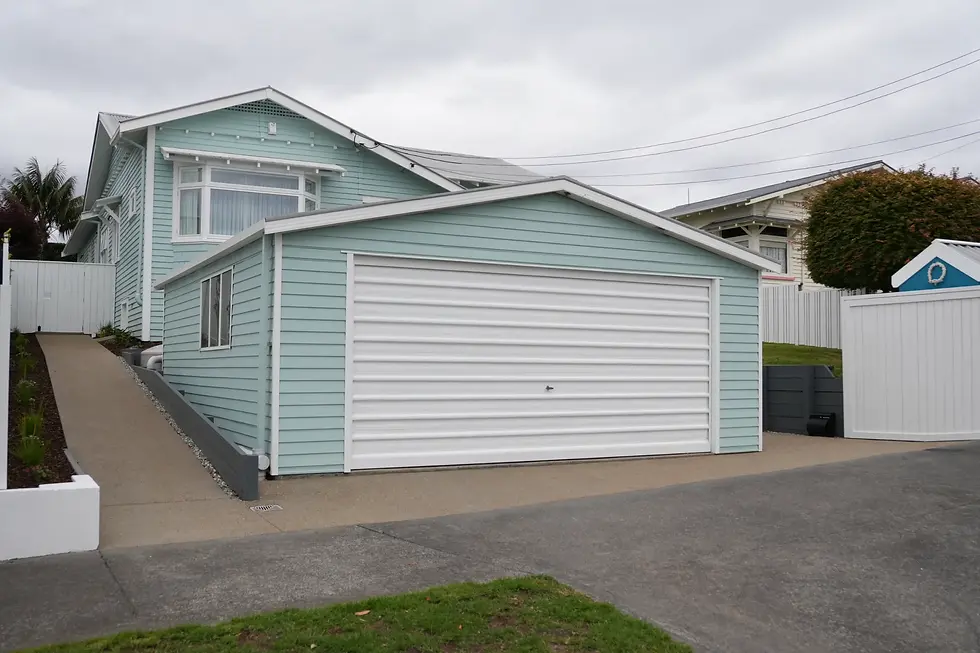
A driveway extension is a new slab poured against an old one, and unless something joins them they behave as two slabs. The ground moves a bit in New Zealand, and the usual result is a new strip that drops away from the old one, or a lip along the line where they meet. Here's how we tie them together, from an extension on our Takapuna deck job.
We build and extend exposed aggregate driveways across Auckland, and every quote starts with a free site visit: get a concrete quote →
The order, at a glance
Base: compacted with the machine until it's solid.
Starters: holes drilled into the edge of the existing driveway, 50 mm below the top, with rebar set in them.
Steel: mesh on top of the base.
Concrete: 25 MPa, exposed to match the existing finish.
Takapuna: a 4.7 m extension
The extension was one part of a bigger job: a 60 m² Vitex deck, a synthetic lawn and the old Kwila reused on the fence and planter, at a house that had just been fully renovated. The driveway piece is 4.7 m long, 0.8 m wide and 100 mm thick.
The base went in first and was run with the machine until it was solid. Then holes were drilled into the existing driveway, 50 mm below its top surface. That depth is deliberate: closer to the surface, the edge of the old slab is more likely to break away, or in Kevin's words, the 50 mm is "so it doesn't pop". Rebar starters went into those holes, so the old slab and the new one are joined, then the mesh, then the pour: 25 MPa concrete, finished as exposed aggregate.
Kevin's reason for all of it: the ground moves a bit in New Zealand. Tied together, the new concrete and the old stay level instead of one sinking.
4 weeks on site
Matching the finish
An extension sits right next to concrete that has been there for years, so the mix is chosen against the old surface. At Takapuna that meant a standard 20 mm exposed aggregate with white coarse limestone and no oxide. Kevin's verdict on the match: pretty good.
Exposed aggregate gives a lot of room to get close. The aggregate type, the size of the stones and the oxide colour all change the look. At Point Chevalier we used 20 mm Mangatangi with 3 kg of black oxide per cubic metre for a darker, warmer finish; at Torbay, 20 mm Longburn pebble with black oxide. How the surface is exposed, and why the timing matters, is in exposed aggregate concrete.
What goes under it
The base under an extension is built the way we build any driveway base. On a typical driveway we dig out about 200 mm, compact 100 mm of GAP20 with a heavy plate compactor and pour about 100 mm of reinforced concrete on top; the Takapuna extension is 100 mm thick. The full sequence, from finding the services to the saw cuts, is in what goes under a concrete driveway.
What actually decides it
The base. Compacted until it's solid. Concrete can't fix ground that settles under it.
The tie. Rebar starters drilled into the old slab, so the two pieces stay together.
The depth of the holes. 50 mm below the top of the existing driveway, so its edge doesn't pop.
The steel. Mesh in the new concrete, as in any slab we pour.
The match. Aggregate, stone size and oxide picked against the old surface.
Where we fit
We do the whole extension ourselves, from the base to the pour and the wash, and at Takapuna it was one part of a bigger build.